
Universities have become too enamored with journal impact factors. These factors are supposed to indicate journal quality. They are used heavily in evaluating the research of scholars, espcially at the time when professors are evaluated for tenure and promotion. But the impact factor of a journal is a bad measure of its quality. This is quite obvious when one looks at distritbutions of citations of journals. This post has an excellent discussion. H/T to Joerg Fliege for posting this link on Google+, where I saw it.
Category: Economics
A good Q&A on climate change
The New York Times has a concise question and answer article on climate change, as the Paris conference on the climate crisis is about to begin. I recommend that everyone reads it and does something to press their government to work towards a good global agreement on mitigating the unfolding train wreck of the Earth’s environment. What homo sapiens needs right now is to show some communal sapience and find policies that will work effectively to prevent the threat to the very survival of humans that human-caused climate change threatens us all with.
Economists have said many times that steps such as establishing a price for carbon and a way to quantify the value of natural capital available to humans are our best hopes for mitigating the disaster. Even as the conference in Paris is unlikely to agree on such terms, I sincerely hope to see at least some pledges for cutting emissions coming from the worst offenders, such as the U.S., China, India, and a few other countries.
Douglass North, RIP
Distinguished economic historian Douglass North died today at the age of 95. This news comes only a few days after the death of Herbert Scarf. Kevin Bryan has written a crystal-clear post explaining the basic ideas behind North’s ccontribution to economics, in Bryan’s blog A Fine Theorem. They key paragraph is below, but I highly recommend reading the whole post.
That historical institutions develop largely to limit transactions costs is a major theme in North’s work, and this paper is a beautiful, highly formal, explication of that broad Coasean idea. Our motivating puzzle – why use formal institutions when reputation provides precisely the same potential for punishment? – can be answered simply by noting that reputation requires information, and the cost-minimizing incentive-compatible way to aggregate and share that information may require an institution. The Law Merchant arises not because we need a way to punish offenders, since in the absence of the nation-state the Law Merchant offers no method for involuntary punishment beyond those that exist in its absence; and yet, in its role reducing costs in the aggregation of information, the Law proves indispensable. What a beautiful example of how theory can clarify our observations!
Ideas for reforming college in the U.S.
The Brookings Institution has collected eight ideas for reforming college, to help promote social mobility, here. I tend to think #3 is the best of these, although I would not want to make higher education totally tuition free for all students, especially those who have the means to pay.
If a legal system can be gamed, it will be, US visa edition
The New York Times has an article on large outsourcing companies gaming the US H-1B visa application process. The nub of the article is this: “Many of the visas are given out through a lottery, and a small number of giant global outsourcing companies had flooded the system with applications, significantly increasing their chances of success.” The entire article is very interesting and reinforces the need for legislators and policy-makers to think about the unintended consequences of their actions.
Chad Jones on the 25th anniversary of Paul Romer’s seminal paper on economic growth
In my first semester in the Ph.D. program at the University of Rochester (Fall 1984), I had the good fortune to be taught by Paul Romer. I took the Math for Econ course from him. In retrospect, I can see clearly what a deep thinker he was already at that time, by the way he presented convex analysis. If later I had not been enamored by William Thomson’s game theory / social choice teachings, I may well have followed Romer in studying growth for my doctoral dissertation.
In 1990, a paper that changed the way economists understand growth was published. The author was Paul Romer. This paper presented a crystal-clear model that incorporated the idea that ideas are non-rival goods (they don’t get depleted when they get used). This paper offered such a fundamental contribution to the economic theory of growth that many economists are celebrating the 25th anniversary of its publication. Here is the contribution, also crystal clear and in plain English, of Chad Jones, to this celebration.
Congratulations to Angus Deaton, winner of the Bank of Sweden Prize in Economics in honor of Alfred Nobel
This was a well-deserved award to Angus Deaton. As usual in the last few years, Tyler Cowen and Alex Tabarrok have timely, well-written explanations of the award. In the spirit of specialization, I refer you to them, where you will also find links to many other sources.
Tyler Cowen’s write-up; Alex Tabarrok’s write-up.
ADDED 2015-10-14: The Economist has a very good write-up, too.
A happy occasion
On Friday, October 9, Temple University had its annual Gallery of Success awards ceremony, as part of homecoming weekend. This year the awardees included Dr. Jeffrey S. Coons, who was my first Ph.D. student at Temple University.
Jeff gave a very generous donation to the Economics Department at Temple University a few months ago. You can read a bit more about this on this page, along with a brief synopsis of Jeff’s career since leaving Temple.
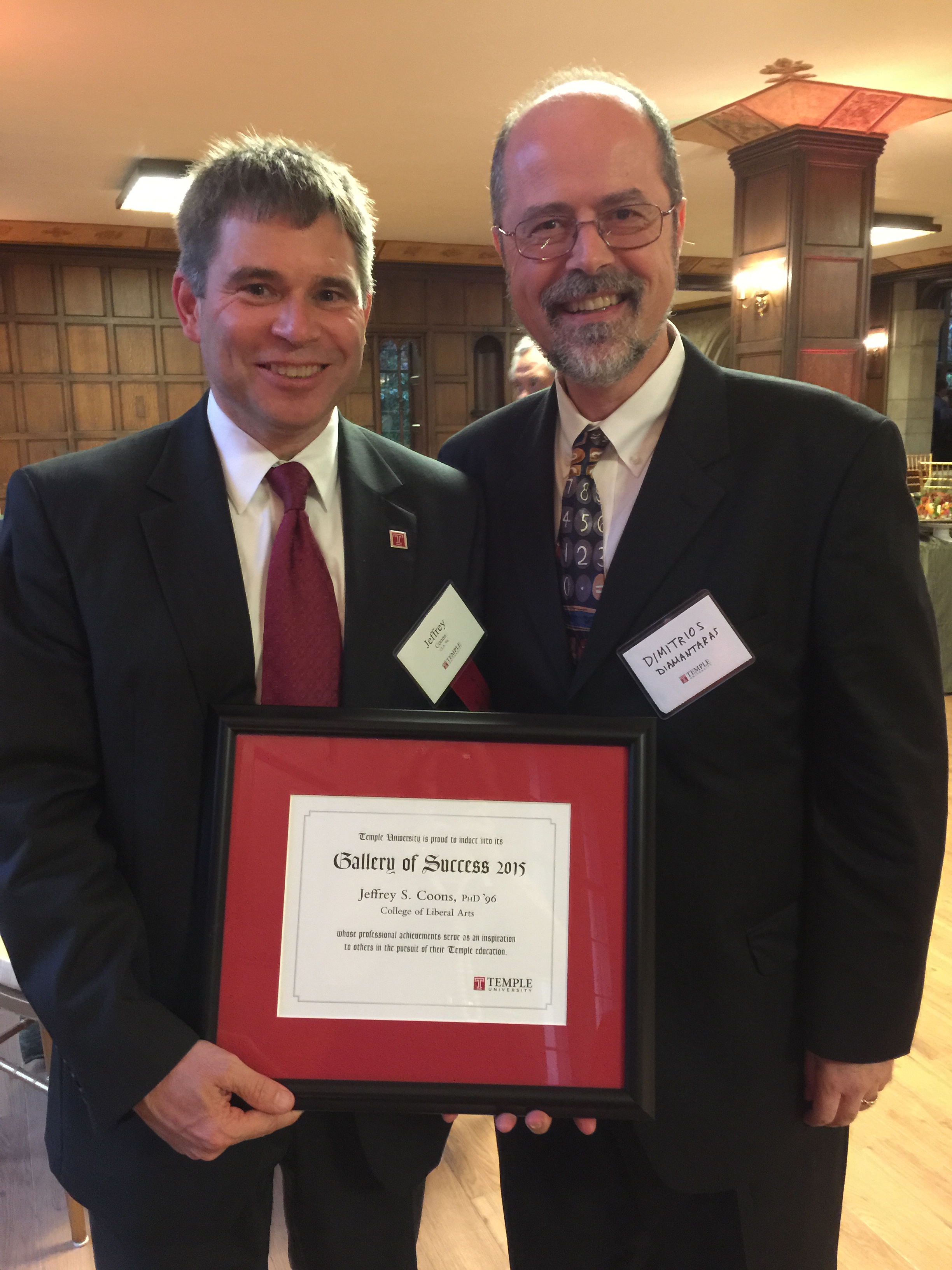
I am grateful to Jeff for his generosity to my department and its graduate students and his recognition of my work in helping him succeed in his doctoral studies. I was delighted to be able to attend the Gallery of Success event and applaud Jeff and all the other awardees for their impressive achievements.
Theory versus evidence in economics
This post by Noah Smith is a good reminder of the need to take care in the scope of applicability of results in economics. It also has links to good posts on this by others and a paper by Ed Leamer.
Paul Romer on the refugee crisis
Let them come and they will build it!
My former teacher Paul Romer has written a thoughtful post on how to help the millions of refugees who would relocate to Western countries, if only they were allowed to do so. I highly recommend following the link about to read it in full. His basic idea is to let the refugees build themselves cities. Cities are economic powerhouses; refugees want dignity and work, not only handouts for basic survival. Put these ideas together and prosper, Western countries.
 The curious incident of DD on the Web