
The sky over our house looked nice today a little before sunset.
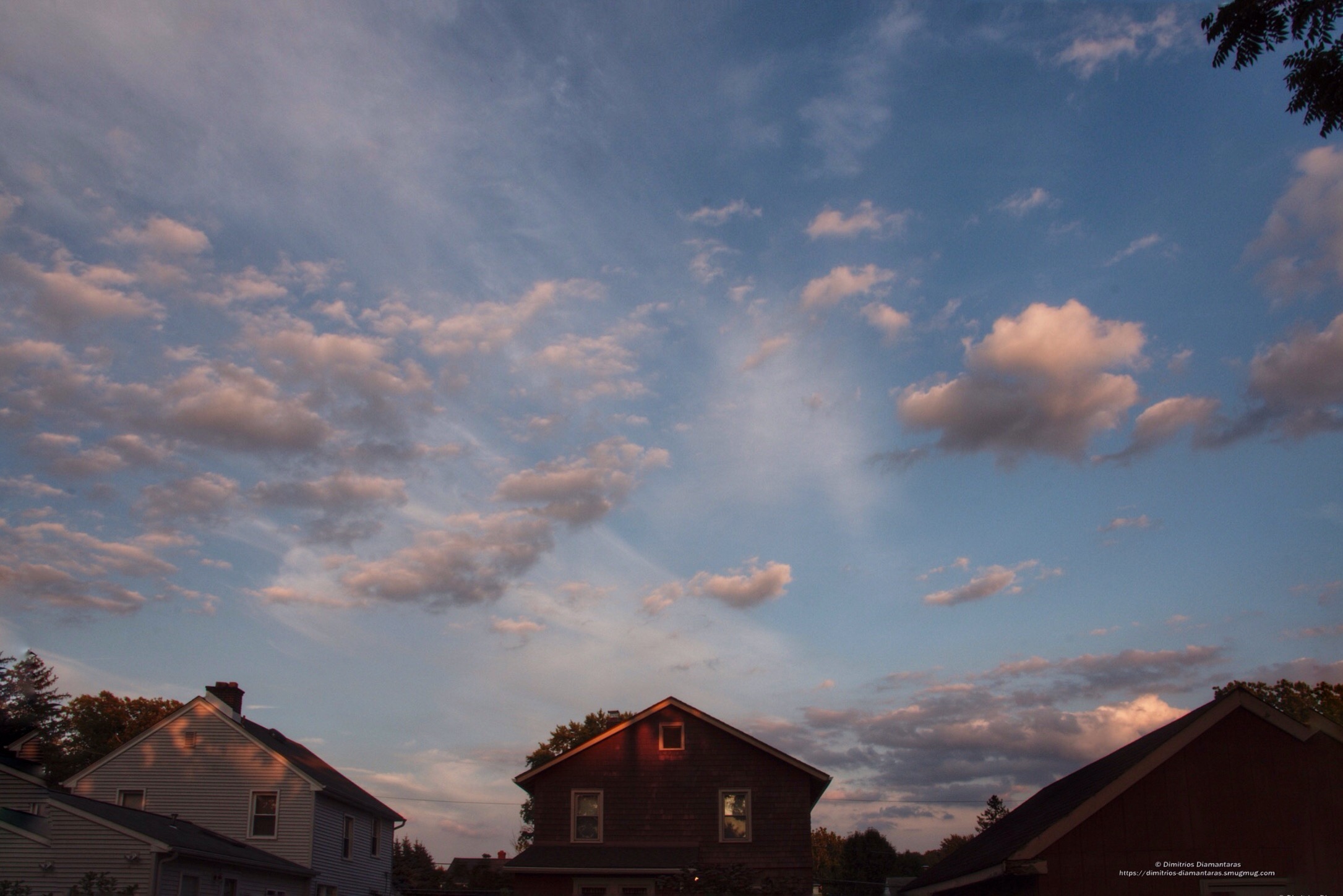
The sky over our house looked nice today a little before sunset.
I was in Ocean City, NJ, recently, and on July 5th I was able to capture a beautiful sunset. Enjoy it here or in the slideshow below, which seems to require Flash:
https://dimitrios-diamantaras.smugmug.com/Ocean-City-NJ-sunset-2016-07/
A couple of years ago, with the encouragement of a few good friends, I started taking photography seriously as an art I could practice. I still consider myself a novice, but my first show, joint with my better half, Marianne Miserandino, is now open in Elcy’s Cafe, in Glenside, PA, and it will go until the first week of August. Meet and Greet party tomorrow from 2 to 4 at Elcy’s. Here’s a gallery with my photos that are part of the show.
This article by Jonathan Rauch in the Atlantic about the disintegration and paralysis of American politics, got me thinking again about how important and maddeningly difficult the problem of mechanism design is.
Don’t run away! It’s simple enough to explain what mechanism design is, even if it is hard to do it well. Mechanism design is the study of how to create rules for important human interactions that will guide the outcomes of such interactions toward desirable ends, when the people interacting follow their own perceived self-interest.
For situations in which coalition-building is not to be expected, the progress mechanism designers have made over the last few decades is palpable and has achieved results. Auctions for airwaves have raised billions of dollars of revenue; kidney exchanges have saved hundreds of lives; doctors in training are better allocated to hospitals and students to colleges and graduate programs — these are just some of the examples of cases where mechanism design had a big impact.
Politics is a quintessential realm of coalition-building. But the brand of game theory that underlies the very same mechanism design approach that has achieved the great results I just mentioned fails to model coalition-building successfully. It may be that problems like fixing US politics are inherently intractable, but it seems that the US Constitution was an inspired solution that did reasonably well for a long time, even as it is beginning to fail now.
Related to the general problem of designing well-functioning democratic political systems, we have the even harder problem of getting disparate political systems to deal with the mounting disaster of planetary environmental degradation, which threatens the entire human species (and a whole lot of other species). Mechanism design theorists simply seem incapable of modeling well such a huge problem of coalition formation. Lest you think I am just criticizing others, I count myself as one of the theorists incapable of envisioning a good approach at this time.
We have evidence, in the works of Elinor Ostrom and subsequent literature inspired by Ostrom’s work, that local solutions to the problem of the commons often develop over time and such solutions, which take the form of formal and informal rules of the game (mechanisms!), often work well to solve local pollution or resource overuse problems.
The hard problem is to develop such solutions for state-wide problems (US politics is an example) and planet-wide problems (the environment), before they destroy any semblance of civilization and the livability of planet Earth. I know there are many brilliant minds working in mechanism design, much more brilliant than mine. I hope I see progress made in modeling coalition formation and its implication for mechanisms in the coming few years, before it is too late.
A good speech by dana boyd deserves to be read widely by all software creators. I don’t particularly care for her singling out Google as an example of a company making wasteful use of the “cloud”, especially as she works for Microsoft, but I suppose she had to do this to stay in her employer’s good graces. But do read it, if you have any interest in making software or thinking about the public policy issues relating to software writing and its implications for the environment and other public welfare concerns.


Sorry I’ve been neglecting this blog lately. Here are some photos from the Morris Arboretum, taken this afternoon, after a storm came through around noon.












 The curious incident of DD on the Web