Wolfram Alpha has been freely accessible on the Web for some time now. It allows anyone to do some of the work that Mathematica can do, in a browser. Now, it looks like the new Wolfram language, a very ambitious project to open up programming to many more people, is also going to be freely available on the Wolfram “cloud”. Details in this post by Wolfram himself. When I get some time freed up, I want to play with this!
Alison Schrager on the new jobs situation for men in the future
This essay by Alison Schrager caught my attention this morning, appropriately for Labor Day. I recommend reading it. It may also make me try to read the new book by Joel Mokyr she mentions, but perhaps this will have to wait for when new technology will give me a few more hours in a day.
Yonatan Zunger about fear, exhaustion, but also hope
Here is an excellent post by Yonatan Zunger about how the Internet has developed into a “moral prosthesis” that lets us know about and empathize with the troubles of people everywhere. This is exhausting, but it may well lead to strengthening our social bonds, when we learn how to manage the stress it comes with. I strongly recommend reading the original at the link.
My smugmug.com site
Recently I was motivated to make a Smugmug website to showcase my photos. I have, as a result, reduced the number of photo posts I make here. But I don’t want to leave you without any photo posts! Here is a gallery of photos of flowers and trees in my Smugmug site, and once you are there, feel free to navigate to other galleries and note that you can order prints of photos you like right from the page: https://dimitrios-diamantaras.smugmug.com/Flowers/
Mathematicians’ good thought habits
Once in a while, I come across a gem of a post that I can file away to use in my teaching and advising, not to mention my constant struggle to think better and more productively as an economist (actually, in any area where I happen to be trying to think well). Here is one such gem, by Jeremy Kun. Enjoy! I am pretty sure you will find it enlightening even if (perhaps especially if) you are not thinking mathematically and consider those who do crushing bores. You’ve been warned!
A dissection of the humanities-sciences distinction
Philosopher Massimo Pigliucci published a great essay on Aeon, entitled “Who knows what”. In this essay, Pigliucci argues that neither the humanities nor the sciences should “have the last word on culture”, to quote a part of the URL of the essay. (It is not often that I find that the URL of a web page has a better title than the page itself, but this one certainly does.) EO Wilson’s book Consilience comes in for a thorough critique, without disparagement. Lots of topics that fascinate me make an appearance and Pigliucci discusses them well: culture and its evolution, the problem of induction, Gödel’s incompleteness theorems—these are some prime examples. I recommend this essay to you wholeheartedly, curious reader. Here are the two concluding paragraphs, which resonated with me perhaps more than all the others:
Seen this way, the differences between philosophy, biology, physics, the social sciences and so on might not be the result of the arbitrary caprice of academic administrators and faculty; they might instead reflect a natural way in which human beings understand the world and their role in it. There might be better ways to organise our knowledge in some absolute sense, but perhaps what we have come up with is something that works well for us, as biological-cultural beings with a certain history.
This isn’t a suggestion to give up, much less a mystical injunction to go ‘beyond science’. There is nothing beyond science. But there is important stuff before it: there are human emotions, expressed by literature, music and the visual arts; there is culture; there is history. The best understanding of the whole shebang that humanity can hope for will involve a continuous dialogue between all our various disciplines. This is a more humble take on human knowledge than the quest for consilience, but it is one that, ironically, is more in synch with what the natural sciences tell us about being human.
Good news about a new antibiotic
I don’t write about science and medicine enough here, which is a pity, but I do want to emphasize the promise this new discovery carries. For a long time, scientists have been warning us that microbes are evolving resistance to existing antibiotics. Unnecessary use of antibiotics, in humans and animals, speeds up the advantage of microbes in the ongoing arms race of antibiotic resistance. This latest discovery is very good news, because it shows a new way to develop antibiotics, in addition to showing a specific new antibiotic that apparently is effective against the fearsome MRSA.
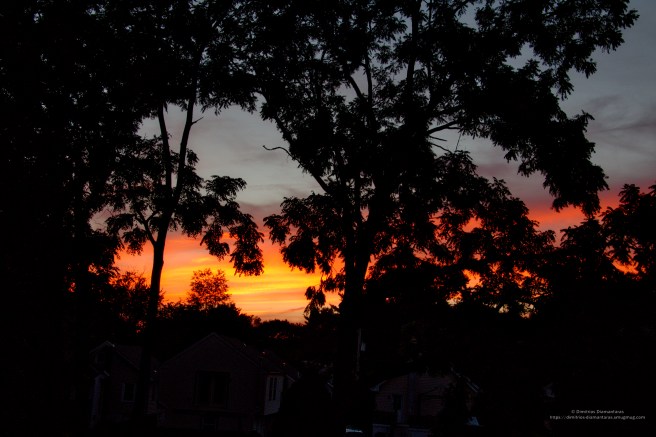
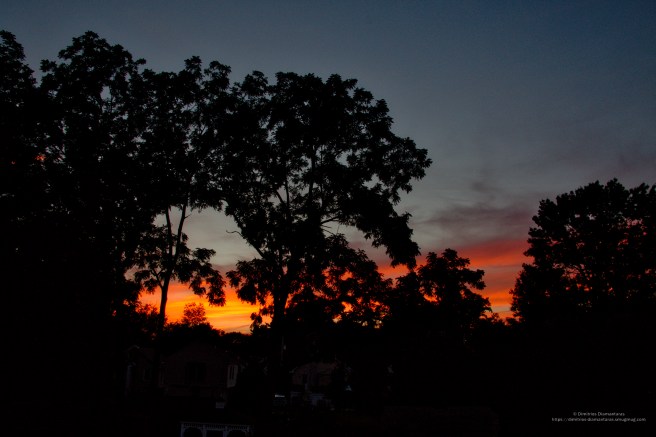
Some photos of today’s sunset


Three links (OK, four) on teaching math
I came across this NPR post today via a post on Facebook. This led me to remember this one and that one, from a recent post and an older post I made myself on FB. The last one of these three links leads to a great discussion of how becoming good at math is a path open to everyone, but it takes hard work. Older people in a position to advise / teach younger ones should be keenly aware of the last one, and help their students/children/tutees adopt a growth mindset.
What an introduction to economics should be
Economics is criticized heavily for its simplistic modeling of human behavior and its overemphasis on the “miracles” competitive markets are supposed to perform. Judging from the typical introductory economics textbooks, I feel that there is plenty of room for an alternative presentation that puts at the center social cooperation, trust, collective goods, and the norms that support all these, before even discussing supply, demand, and the efficient allocation of resources. The presentation would then continue with standard economics topics, but with clear indications of the power AND limitations of each economic theory. Interactive examples should ideally be provided and comments by readers allowed.
I have started such a project which will be available online once completed. I will occasionally write update reports by posting on this blog.
 The curious incident of DD on the Web