Useful tips for economists on using LLMs for research and teaching

Back in the remote past, I used to write posts about economics on this blog and generally about things that caught my fancy, in addition to posting some of my photography. I am returning to this pattern now, after months of inactivity, and I will try to keep the practice of writing daily here going.

For today, I start with what looks like a good page with tips on how to use LLMs for research and teaching in economics. The bits about having LaTeX code auto-produced and making graphs out of tables automatically are the most interesting to me, but you, fellow economist, will probably find more useful stuff there: https://paulgp.github.io/2024/06/24/llm_talk.html

Big thanks to Paul Goldsmith-Pinkham (@paulgp on Twitter) for consistently posting helpful material, such as the above and his lecture notes for his Applied Empirical Methods Class.

PS. I had the AI feature of WordPress generate the featured image for this post. I let it do it without additional instructions, simply based on my words (before the PS). I thought it did a good job. Comments on the post or the featured image welcome!

Video lecture on Power and Progress

Three weeks ago, Daron Acemoglu gave a talk on Markus Brunnermeier’s “Markus Academy” on YouTube on the Acemoglu-Johnson book “Power and Progress”, about which I wrote a short post in May. I watched this talk today and I heartily endorse it both as a lively and short summary of the book and for the good questions Brunnermeier asked. I liked it enough to immediately add it to my Economic Inequality course syllabus for the fall. You can watch it here: https://youtu.be/eGqaOhTq060   

Acemoglu and Johnson on the need to control technological progress

I’m finally returning to this blog with a post on economics and technology. It’s not much of a post, but it does represent an end to a long period of neglect of the blog.

Daron Acemoglu and Simon Johnson have a new book out, Power and Progress, released yesterday. I just grabbed an ebook copy and started reading it. This post will be the first of a series in which I will record my reactions. Here is an excerpt from the end of the preface, to show the gist of the main argument in the book:

“We wrote this book to show that progress is never automatic. Today’s “progress” is again enriching a small group of entrepreneurs and investors, whereas most people are disempowered and benefit little.
A new, more inclusive vision of technology can emerge only if the basis of social power changes. This requires, as in the nineteenth century, the rise of counterarguments and organizations that can stand up to the conventional wisdom. Confronting the prevailing vision and wresting the direction of technology away from the control of a narrow elite may even be more difficult today than it was in nineteenth-century Britain and America. But it is no less essential.”

Excerpt From
Power and Progress
Daron Acemoglu & Simon Johnson

Update 2023-06-09: back from a trip, still planning to finish the book are post a review.

A good Twitter thread on COVID-19, inequality, morbidity, and vaccines

I just read the thread that starts with this tweet: https://twitter.com/thrasherxy/status/1524780425847181312?s=21&t=g7F-ikgMkS9so5zKI7PbHQ by Dr. Thrasher.

When I read the first tweet, I immediately saw “base-rate fallacy” flash in front of my eyes. It turned out not to be this at all. I recommend the thread, all of it, and some thinking about the malignant combination of inequality with the COVID-19 pandemic. (Others have discussed the insidious effects of inequality on the pandemic, of course. I am putting together some of those discussions and research for my materials for the economic inequality course I teach and the book on it I am drafting.)

I fear that our society, here in the U.S., is so committed to ignoring the importance of public goods, such as public health measures that mitigate infectious-disease transmission, that it is simply unable to deal with this pandemic effectively. As a result, we will probably see years of mutating Coronaviruses of the SARS-COVID variety, and will be consistently responding the wrong way to their emergence.

(I could of course have responded on Twitter, but I have decided to use this blog more and Twitter less for discussions like this. I am letting this be auto-tweeted, though. I may cease contributing to Twitter at all, depending of how big a mess EM makes of it once it is under his control.)

Income Inequality and COVID-19

It has been a very long time since I last made a post here. I am coming back with a post about the relationship between income inequality and COVID-19.

The latest issue of The Economist has an article on this topic, which led me to three recent studies about this relationship and an interesting Twitter thread. (Do watch out for the careless conflation of wealth with income in the second tweet in the thread.) I will say a few words for each of the three studies. Before I do that, I need to issue the disclaimer that I am not a statistician or an econometrician, therefore I cannot, and will not, claim to evaluate the appropriateness of the statistical modeling in these studies.

Let’s start with “Association Between Income Inequality and County-Level COVID-19 Cases and Deaths in the US”, by Annabel X. Tan, MPH; Jessica A. Hinman, MS; Hoda S. Abdel Magid, PhD; Lorene M. Nelson, PhD, MS; Michelle C. Odden, PhD, from JAMA Network Open, doi:10.1001/jamanetworkopen.2021.8799. The authors collected data on COVID cases and deaths for a year (2020-03-01 to 2021-02-28), as well income inequality (measured by the Gini coefficient) for 3220 counties in all 50 states plus Puerto Rico and DC. Their main finding was a positive correlation between income inequality and COVID cases and deaths, which was most pronounced in the summer of 2020. Several additional variables were included as controls, such as the poverty rate, age, race, mask use, crowding, educational level, urban versus rural population share, and availability of physicians. I find it remarkable that income inequality showed up as correlated with COVID cases and deaths in the presence of all these additional variables that one would expect to be more strongly correlated with COVID outcomes.

Next, we’ll talk about “COVID‐19 and income inequality in OECD countries” by John Wildman, The European Journal of Health Economics (2021) 22:455–462 https://doi.org/10.1007/s10198-021-01266-4. The COVID variables are cumulative deaths per million and recorded daily cases per million in the early months of the pandemic. In the words of the author, “The results demonstrate a significant positive association between income inequality and COVID-19 cases and death per million in all estimated models. A 1% increase in the Gini coefficient is associated with an approximately 4% increase in cases per-million and an approximately 5% increase in deaths per-million.” The author proposes that income inequality is a proxy for other variables that correlate with bad COVID outcomes, such as “poor housing, smoking, obesity and pollution.”

Finally, let’s take a look at “The trouble with trust: Time-series analysis of social capital, income inequality, and COVID-19 deaths in 84 countries” by Frank J. Elgar, Anna Stefaniak, and Michael J.A. Wohl, Social Science & Medicine 263 (2020) 113365. Here is the abstract of the paper:

Can social contextual factors explain international differences in the spread of COVID-19? It is widely assumed that social cohesion, public confidence in government sources of health information and general concern for the welfare of others support health advisories during a pandemic and save lives. We tested this assumption through a time-series analysis of cross-national differences in COVID-19 mortality during an early phase of the pandemic. Country data on income inequality and four dimensions of social capital (trust, group affiliations, civic re- sponsibility and confidence in public institutions) were linked to data on COVID-19 deaths in 84 countries. Associations with deaths were examined using Poisson regression with population-averaged estimators. During a 30-day period after recording their tenth death, mortality was positively related to income inequality, trust and group affiliations and negatively related to social capital from civic engagement and confidence in state in- stitutions. These associations held in bivariate and mutually controlled regression models with controls for population size, age and wealth. The results indicate that societies that are more economically unequal and lack capacity in some dimensions of social capital experienced more COVID-19 deaths. Social trust and belonging to groups were associated with more deaths, possibly due to behavioural contagion and incongruence with physical distancing policy. Some countries require a more robust public health response to contain the spread and impact of COVID-19 due to economic and social divisions within them.

I find these papers extremely interesting, and I want to make them part of my economic inequality course. You could say that this post is my very rough first reaction, simply noting the main conclusions of this research, conclusions that point out a clear connection between income inequality and the COVID-19 pandemic outcomes.

Congratulations to Paul Milgrom and Robert Wilson for winning the 2020 Economics Nobel Prize

The 2020 Bank of Sweden Prize in Economic Sciences in Honor of Alfred Nobel was awarded today jointly to Paul Milgrom and Robert Wilson of Stanford University for their work in Auction theory. Here is the popular information document on the Nobel Prize website, complete with some really great graphics: https://www.nobelprize.org/prizes/economic-sciences/2020/popular-information/

Hearty congratulations to the winners! More from me on this blog a little later. I know a bit about auction theory and have taught parts of the theory — now I will prepare a lecture on this award to be delivered on October 23d. Details to follow.

BPEA conference on COVID-19 and the economy

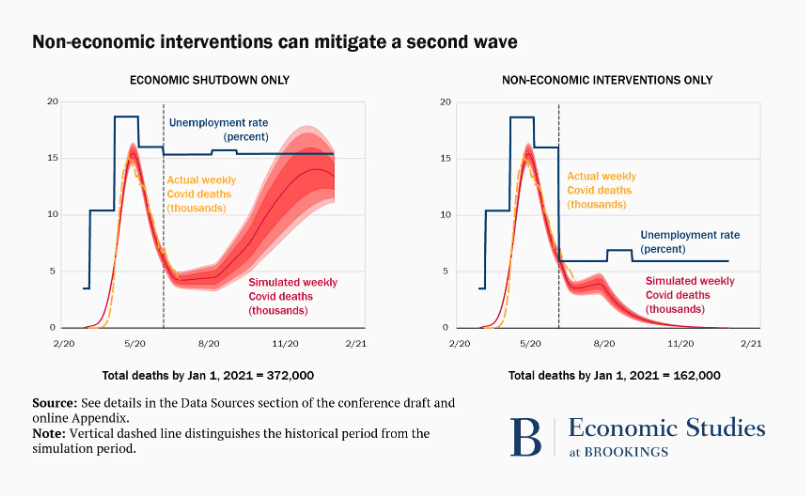
The Brookings Papers on Economic Activity mini-conference on COVID-19 happened today as a webinar. I am reading several of the paper drafts that were discussed (but did not have the chance to tune in to the webinar). I may write more here about these papers, but for now I want to emphasize this graph from the paper by Baqaee et al., Policies for a Second Wave:

The graph is self-contained, so I don’t feel the need to explain it more.

I may indeed post again, in more detail, about this and other papers presented in this conference.

A paper that simulates COVID-19 in a University

The paper “Simulating COVID-19 in a University Environment“, written by Philip T. Gressman and Jennifer R. Peck appeared in ArXiv on June 5, 2020. It contains a stochastic agent-based model that simulates the likely progress of COVID-19 disease transmission in a fictional U.S. University with 20,000 students and 2,500 faculty members that opens for a semester of 100 days in a world with certain (unknown) members of the general population infected with the disease. It also includes an analytical model that supports the main conclusions drawn from the simulations. It complements the paper “The small world network of college classes: Implications for epidemic spread on a university campus” by K. A. Weeden and B. Cornwell.

How to open a University campus relatively safely and conduct instruction with minimal numbers of infection and the maximal possible effectiveness of instruction is keeping University and College administrators up at night, not to mention faculty members like myself, who dread the possibility of being forced to teach in a classroom at a risk to their health they deem too high. Papers like the Gressman and Peck paper are valuable contributions to administrators’ decision-making and I hope they are taken seriously by them.

The main conclusions of the paper can be summarized simply. I do so now and I discuss the assumptions of the paper at the end of this blog post. The two outcomes the simulations focus on to evaluate the effectiveness of various infection control measures are (1) the total number of infections and (2) peak quarantine population.

Disclaimer: I read with reasonable care the main body of the paper and glanced at the part of the appendix where the results of robustness testing are reported. I did not read the analytical model presented at the end of the appendix, Section 5.3.

Main conclusions of the simulations:

  • The rate that testing for COVID-19 yields false positive results is unexpectedly and massively important for the results. This is in the context of the regime that several Universities (including mine) have announced for Fall 2020, where there would be extensive testing of community members and tracing and isolation of contacts that test positive. Such tracing would likely result in quarantining 10 to 20 students for every student who tests positive, which imposes a high cost in terms of the number quarantined.
  • An almost certain way to guarantee widespread infection is to allow classes larger than 120 students to meet face to face. As part of the main intervention the authors consider, classes with over 30 students would meet online only.
  • It matters a lot that students refrain from “all contact outside of academic and residential settings” (page 2).
  • Instructors have to prepare for online delivery of instruction to quarantined students, expecting at least 10% of students in any class to be quarantined on a given week. The experience of these students would not be the same as those attending class in person.

I found the paper convincing and its conclusions credible. I do want to emphasize some limitations of the analysis of the paper stemming from its assumptions. These are mostly made clear by the authors but do tend to push in the direction of making the conclusions overoptimistic. I offer these critical comments as a caution for readers, especially should they be University administrators, and not in order to diminish the contribution of the authors; obviously, all analyses have their limitations.

  • The first limitation is prominent in my own calculations for my personal safety: exposure to infection from using public transportation to commute to campus is not considered in the paper. Numerous faculty and students can be expected to use public transportation and import infections to campus in this way.
  • Compliance of individuals with regulations is assumed throughout. What are the chances individuals aged 18 to 22, to speak of the traditional age students who are still a large proportion of most campuses, will act responsibly outside of class and dorm, not going to multiple parties without any physical distancing in place? It is one thing to require mask-wearing in the classroom and another thing to expect mature behavior outside the campus setting by young people who also realize that their personal risks for a serious and possible fatal infection are small.

I could offer more minor nitpicking comments on the assumptions of the analysis, but I am stopping here, after having listed my main thoughts about the limitations of the paper. I view it as a very good and interesting paper and I look forward to additional simulations along the lines of those it offers that expand the reach of the model with assumptions amended along the lines I outlined in my critique.

Online tool for tracking the economic recovery from COVID-19

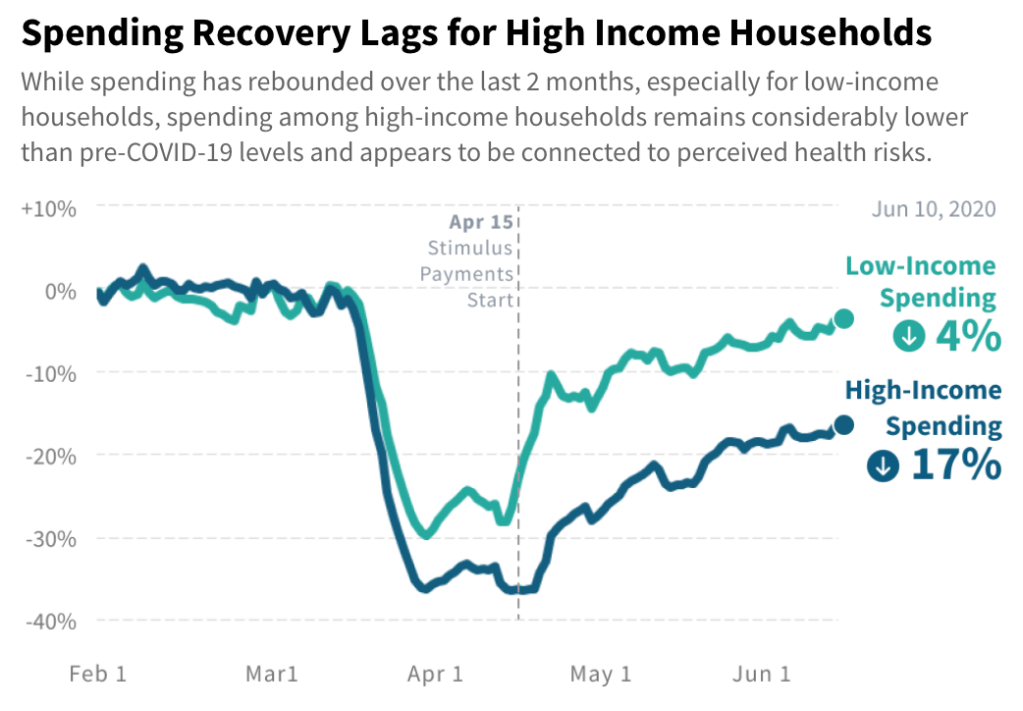
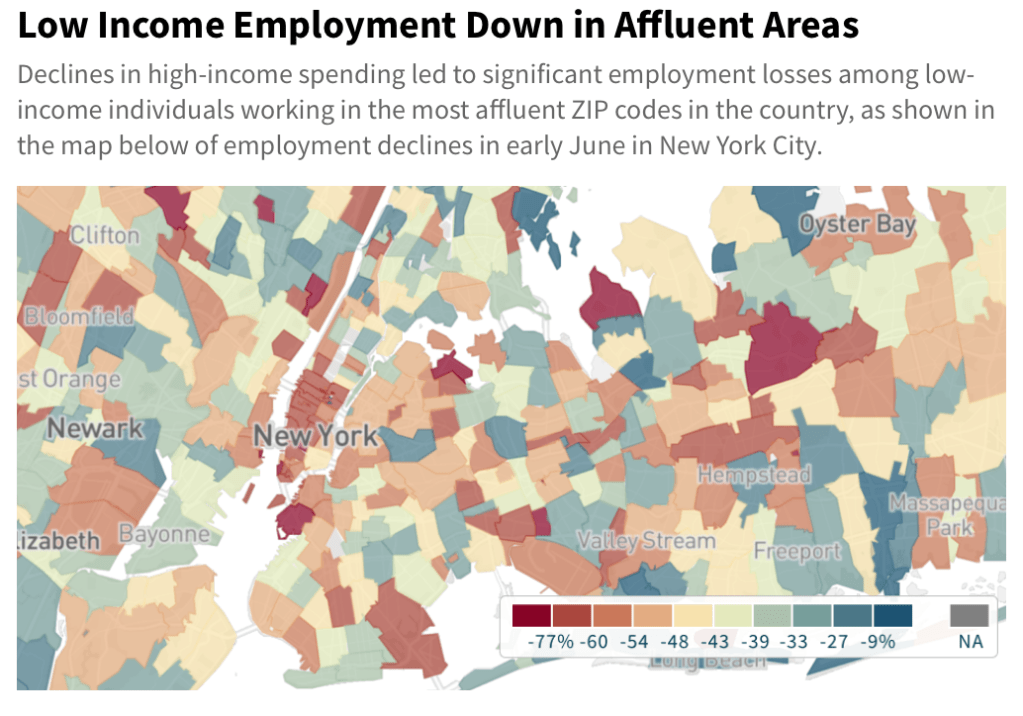
The paper “How Did COVID-19 and Stabilization Policies Affect Spending and Employment? A New Real-Time Economic Tracker Based on Private Sector Data”, by Raj Chetty, John N. Friedman, Nathaniel Hendren, Michael Steiner, and the Opportunity Insights Team, was released on June 17, 2020. The authors have created a new freely accessible online tracker that allows you to see the evolution over time of many data series that give an idea of how the US economy and society are recovering from the COVID-19 pandemic. Both the paper and the tracker are highly recommended. Visit the tracker here: https://tracktherecovery.org/. To give you a flavor of what data the tracker contains and the visualizations it makes available, here are two screenshots from the home page. There is a wealth of data in the tracker and the visitor can create and almost endless variety of graphical representations of selected data sets.

Reaction to Katharina Pistor’s book “The Code of Capital”

I recently read this book and decided that I will include it in the syllabus of my Economic Inequality course. A few days ago, when I indicated on Twitter my intention to write about the book in this blog, I was intending a review. However, I found good reviews online, to which my own review would have little to add. These are: a post in the Law and Political Economy blog by Sam Moyn, and this piece by Rex Nutting on MarketWatch. To these, I can add little of value from the point of view of a legal scholar, such as Sam Moyn, or a commentator on political economy, such as Rex Nutting. Instead, I will quote from the publisher’s online blurb, so you can get a quick idea what the book is about, before proceeding with my comments.

Capital is the defining feature of modern economies, yet most people have no idea where it actually comes from. What is it, exactly, that transforms mere wealth into an asset that automatically creates more wealth? The Code of Capital explains how capital is created behind closed doors in the offices of private attorneys, and why this little-known fact is one of the biggest reasons for the widening wealth gap between the holders of capital and everybody else.

In this revealing book, Katharina Pistor argues that the law selectively “codes” certain assets, endowing them with the capacity to protect and produce private wealth. With the right legal coding, any object, claim, or idea can be turned into capital—and lawyers are the keepers of the code. Pistor describes how they pick and choose among different legal systems and legal devices for the ones that best serve their clients’ needs, and how techniques that were first perfected centuries ago to code landholdings as capital are being used today to code stocks, bonds, ideas, and even expectations—assets that exist only in law.

I am intrigued by this book, in my capacity as an economist, for two main reasons.

  1. The book gives a new and insightful perspective on the nature of capital, not long after Thomas Piketty’s Capital in the Twenty-First Century, a book most certainly discussed in my course on economic inequality. One big criticism of Piketty’s concept of capital, leveled by other economists, is that it diverges from the standard use of “capital” in macroeconomic / growth theory, even though Piketty does appeal to some results from this theory in his analysis. Pistor offers in her book an intriguing definition of capital as the aggregation of a myriad strategies of highly-paid lawyers, who shop around existing legal systems to create encodings of assets into concepts that can be defended as being legal in some court of a recognized state, encodings that serve to make up assets out of “thin air” and make these assets long-lived, accumulating over time, and convertible to money when their owners desire. I am not a macroeconomist, but I am eager to see what my colleagues in that field will come up with by engaging with this definition. After all, Paul Romer’s 2018 Nobel prize was for his incorporation of ideas into growth theory, as boosting the productivity of all other inputs to production (yes, I am simplifying). Intellectual protection legal regimes matter for this for obvious reasons. Pistor essentially says that the ideas of lawyers are part of this process. She explicitly discusses how these lawyerly inventions have expanded the scope of intellectual property protection (simultaneously shrinking the public domain in the realm of ideas), but she says so much more about these lawyerly inventions that there ought to be plenty of material here for some new macroeconomic theory.
  2. The second reason this book intrigues me is that it suggests a diagnosis for the disease of ever-increasing inequality in incomes and wealth levels, with the attendant problems of social polarization, undermining of democratic systems and norms, and empowerment of more and more economic and political oligarchy. It is not the job of a law professor like Pistor to suggest to economists interested in political economy and mechanism design how to think about modeling a way forward to formulate effective social and policy responses to these trends. But she has done all such economists (and I do count myself as part of this group) a favor by her diagnosis. I hope the policy designs and suggestions from economists are not long in coming.